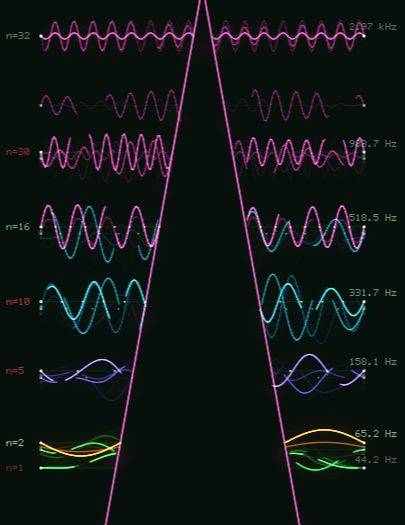
A guitar string and a string in string theory obey the same equation. I built visuals for my synth
Vespene out of that: every partial of the sound becomes a vibrating string, and dragging the picture changes the sound.
Below is the maths step by step, each step with a small animation, and then what each step looks like inside the synth.
Point at a formula (tap on a phone) and the UFO beams down a bit more.
> THE DERIVATION
One idea, used twice: nature keeps the shape something sweeps out as small as possible. A point sweeps a line, a string sweeps a surface.
STEP 1
a point particle draws a line
Moving through spacetime, a particle traces a worldline. The action is minus its mass times the length of that line.
S = −m ∫ ds = −m ∫ dτ √(−ẋμ ẋμ)slow speeds give back ½ m v², the kinetic energy
S = ½ ∫ dτ ( e−1 ẋ² − e m² )an extra field e(τ) removes the square root
the worldline, inside its light-cone. time goes up.
STEP 2
a string draws a surface (nambu–goto)
A string moving through time sweeps a worldsheet. Same logic: the action is minus the tension times the area.
SNG = −T ∫ dτ dσ √(−det hab)h = the geometry the sheet inherits from spacetime
T = 1 / (2πα′)for the string between quarks (QCD) α′ ≈ 0.9 GeV−2, measured from meson spectra; for a fundamental string it is unknown
snapshots of an open string stacked through time.
STEP 3
drop the square root (polyakov)
Same trick as step 1, one dimension up: give the sheet its own metric γ. The action becomes a free 2D field theory.
SP = −(T/2) ∫ dτ dσ √(−γ) γab ∂aX · ∂bX
It has a rare symmetry, rescaling the sheet (γ → e2ωγ), which only works in exactly two dimensions. That is why the worldsheet is a 2D conformal field theory.
the same sheet, stretched by a local rescaling: the physics does not change.
STEP 4
the wave equation appears
Use that symmetry to flatten the sheet and the equation of motion is the wave equation, the same one as a guitar string.
(∂τ² − ∂σ²) Xμ = 0
Ẋ · X′ = 0 , Ẋ² + X′² = 0the leftover constraints
this is the equation of a plucked string. two waves run in opposite directions and bounce off the ends.
a pluck: two travelling waves, reflected at the ends.
STEP 5
solve it: the harmonic series
X = x + 2α′pτ + i√(2α′) Σn≠0 (αn/n) e−inτ cos(nσ)
Each αn is the n-th overtone. Their combinations obey the Virasoro algebra:
[Lm, Ln] = (m−n) Lm+n + (D/12) m(m²−1) δm+n,0
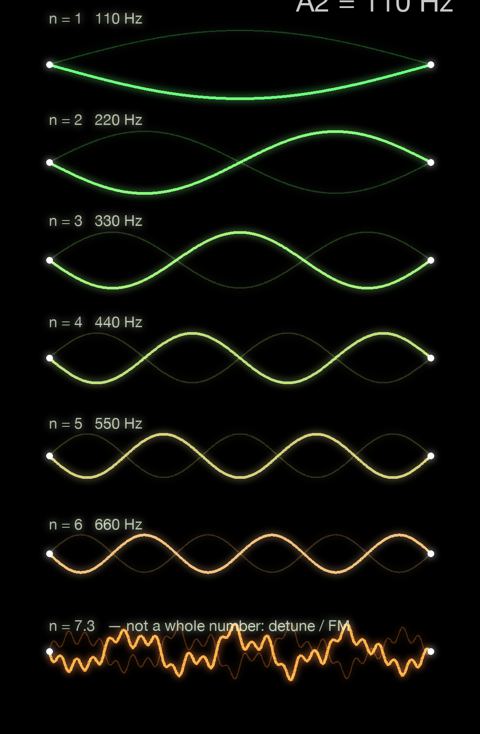
n = 1, 2, 3 … are the partials of the sound. the strings style draws exactly these.
modes cos(nσ), n = 1…5.
STEP 6
quantise: overtones become particles
α′ M² = N − 1
N counts how much the string is excited. N = 0 is an unstable tachyon, N = 1 is massless like the photon, higher N is a tower of heavier
particles on the line J = α′M² + 1. A closed loop has two sets of overtones, and its massless level contains the graviton.
All of this is only consistent in D = 26 dimensions (10 for the superstring): the extra term above has to cancel.
spin against mass²: the highest spin of each level sits on the line; the other states sit below it.
> AROUND IT
Four more pictures from the same world, each one a visual idea for the synth.
FLUX TUBE
the rubber band between quarks
E ≈ σ · r , σ ≈ 1 GeV/fmroughly 16 tonnes of pull; stretch it far enough and it snaps into a new pair
pull two quarks apart: the tube snaps.
BRANES
where open strings end
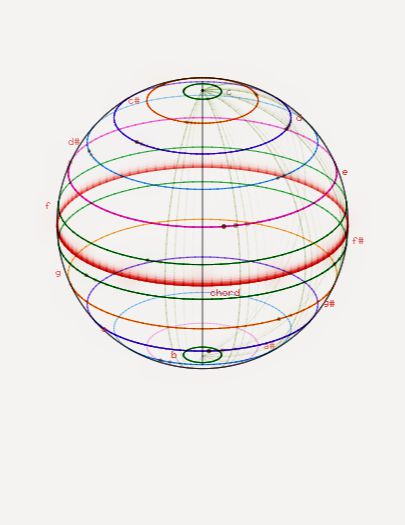
SU(2) at level k: k + 1 branes · charge counts mod k + 2on the 3-sphere the allowed branes sit at fixed latitudes; enough of them at one pole turn into one brane at the other
latitude branes, k = 6.
CARROLL
let light stop
ds² = −c² dt² + dx² , c → 0light-cones close to lines: nothing moves through space, every point only has time
as c goes to 0 the light-cones close.
SCALE
how small is a string
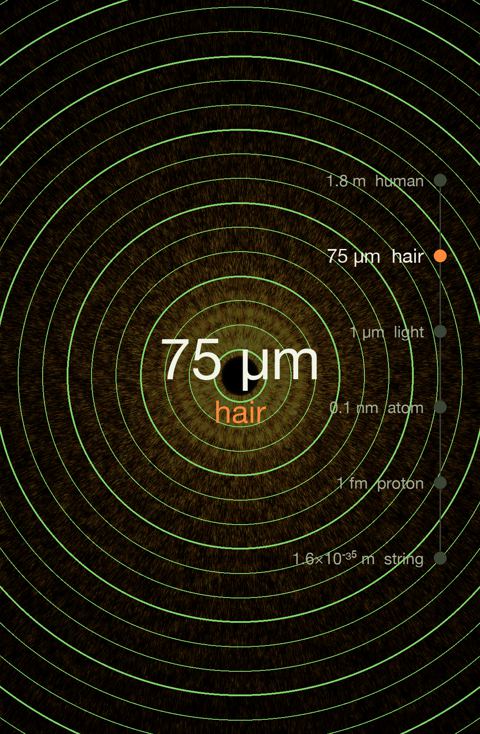
1.8 m → 1.6 × 10⁻³⁵ mfrom a person to the Planck length, about 35 powers of ten. strings are often assumed to be near this size; nobody has measured it
one ring per power of ten.
> INSIDE VESPENE
Each formula became a style in the synth. They listen to the sound, and you can drag them: dragging edits the patch.
Stills straight out of Vespene:
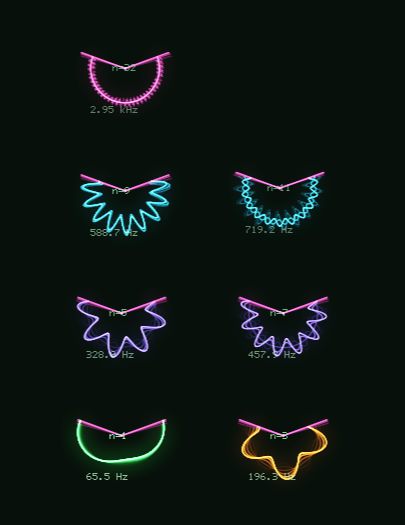
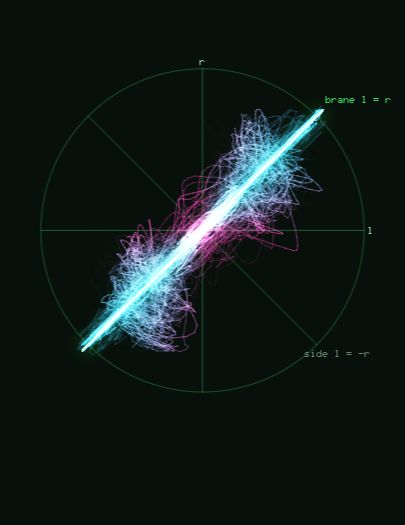
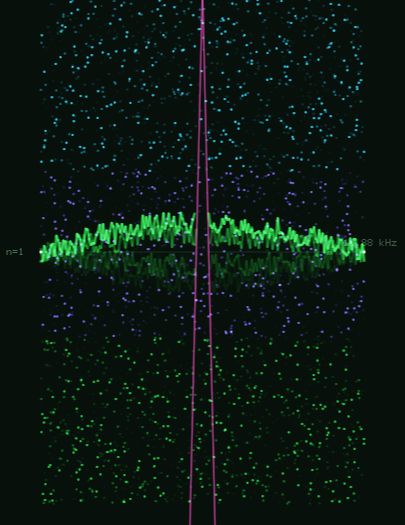
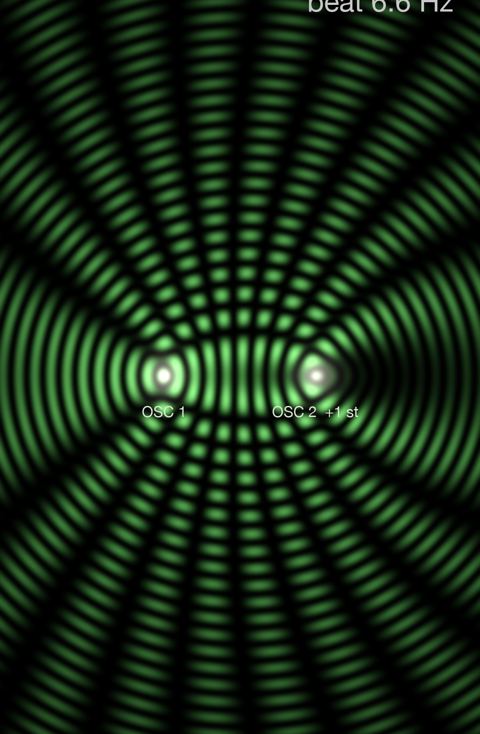
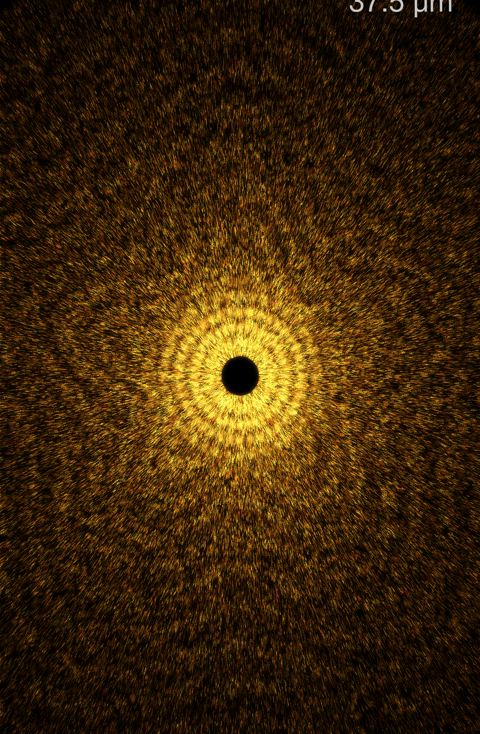
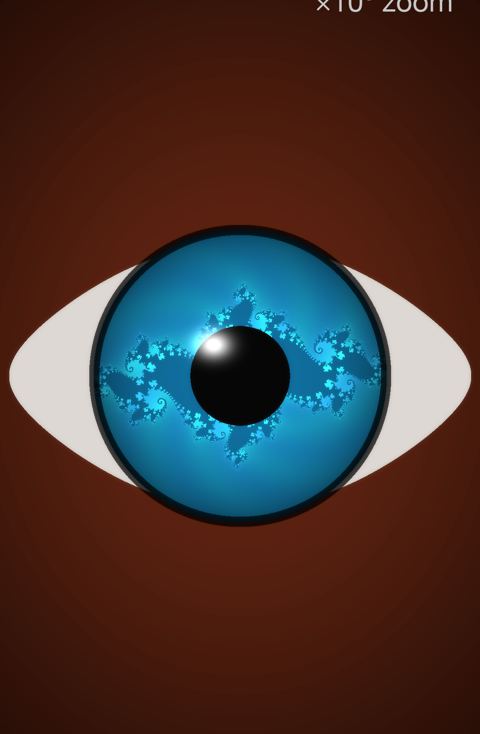
STRINGSn = f / f₀every strong partial is a string with n bumps; detuned partials break.drag a string = EQ thereLOOPSclosed string, n bumps roundthe same partials as closed loops, the graviton's kind of string.same drag as stringsSCOPEx = L , y = Rthe diagonal L = R is a brane; mono sits on it, stereo pulls off it.drag = osc 2 tune, chorusSPHEREk + 1 latitude ringsevery note of the tuning is a ring; a held chord condenses into one.drag a ring = retune that noteCONEdeficit angle δa wedge of space cut out and glued; the angle follows the unison spread.drag the tip = unison voicesMELTc : 0 → 3as the sound gets noisy the strings melt into a continuum band.drag the band = noise, morphWAVESbeat = |f₁ − f₂|the two strongest partials as two wave sources; near unison it beats slowly.drag = tune, chorusLIGHTλ = 343 m/s ÷ flight pours out of a dark centre; the ruler shows the real wavelength in air.drag = filter, reverbIRISz → z² + ca Julia-set iris you zoom into while notes hold; the pupil opens with the low end.drag = filter, wavetableZOOM100 → 10−35 man overlay on every style: one trip down the scales per 32 bars.on/off in the window
coming next: RG flow (sounds sliding to a simpler fixed point), carroll freeze (light-cones close, the sound holds),
wavetable brane, and a particle set (flux tube, neutrino beating, the higgs bowl).
the string keeps its surface as small as it can. that gives the wave equation, the overtones are the particles,
and the same overtones are what you hear.